There is a question that comes up on most new door consultations when a homeowner has an attached garage: is the insulated door worth the extra money?
The honest answer is: it depends on your garage and how you use it. But for most attached garages in Carbon County and the Poconos — where winter temperatures routinely drop into the teens and single digits, where the garage is often directly below a bedroom or living room, and where the door may account for a significant portion of the exterior wall area — the insulated door is usually the right choice.
Here is what the insulation difference actually does, what the R-value numbers mean in practical terms, and when the upgrade makes sense versus when it does not.
Why the garage door is a thermal problem
Walk into a heated garage attached to your house on a January morning in Palmerton. Then open the garage door. The temperature in the garage drops quickly and the cold pours in — not just at the doorway but through the entire wall assembly over the next several minutes.
The garage door is often the largest opening in the exterior building envelope. A standard 16-foot double-car door has 112 square feet of exposed surface area facing the outside. A single 8-foot door has 56 square feet. For comparison, a standard exterior entry door is about 20 square feet.
An uninsulated steel garage door is essentially a large metal panel with no thermal resistance. Steel conducts heat rapidly. In a Carbon County January, the inner face of an uninsulated door can be nearly as cold as the outdoor air temperature. Heat from the garage radiates through the door and out. Cold from the door surface radiates into the garage.
If the floor above the garage is finished living space — a bedroom, a home office, a living room — the uninsulated garage door directly affects the comfort and heating cost of that space.
What R-value means for garage doors
R-value measures thermal resistance — how well a material resists the transfer of heat. Higher R-value means better insulation. In garage doors, you will typically see:
No insulation: R-0. A single layer of steel with no insulating core. Essentially no thermal resistance beyond the mass of the steel itself.
Single-layer polystyrene insert: R-4 to R-7. A sheet of expanded polystyrene (rigid foam) placed in the door panel cavity. A significant improvement over uninsulated, though the polystyrene is not bonded to the steel skins — there is air gap potential around the edges.
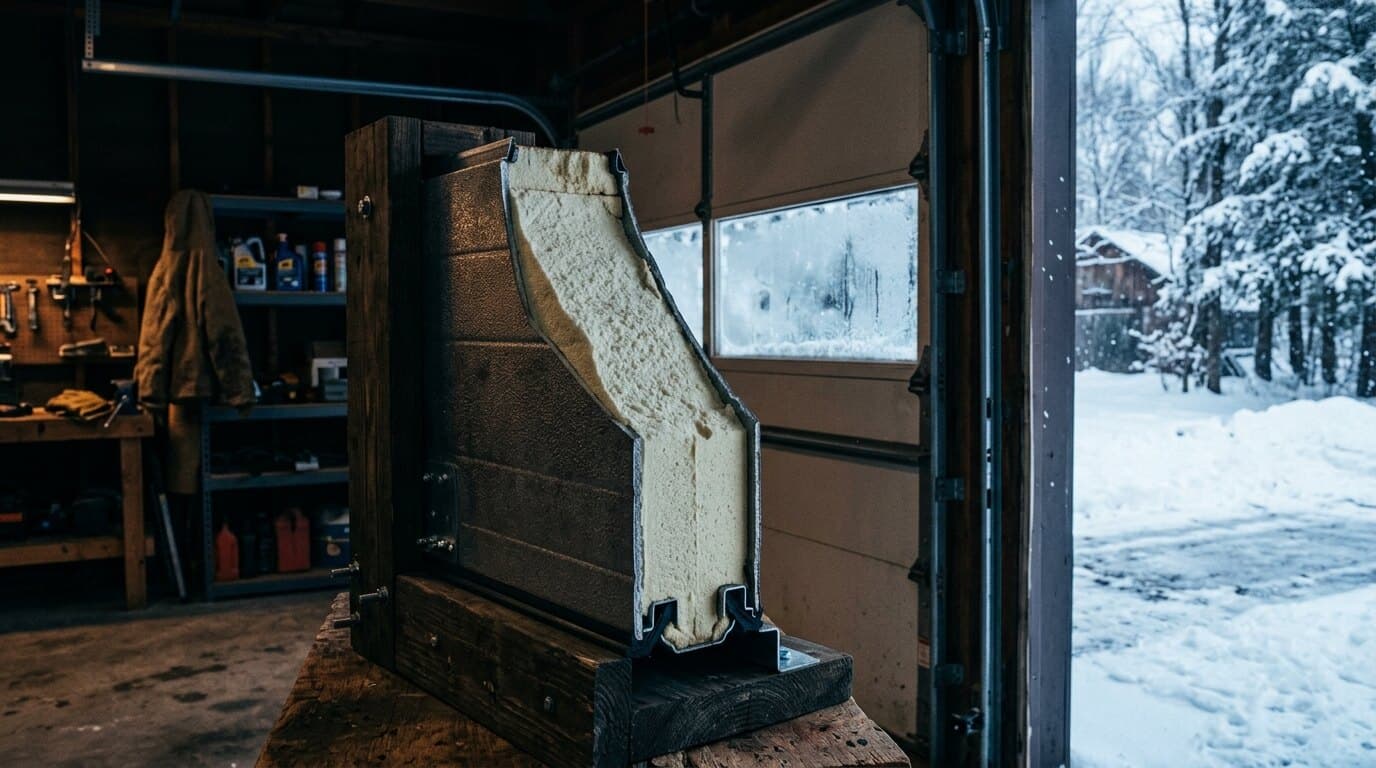
Polyurethane foam-filled (two-layer or three-layer construction): R-12 to R-18, depending on the door and foam depth. Polyurethane foam is injected between the steel skins and bonds to both, creating a structural composite as well as a continuous insulating layer. No gaps at the edges. Better thermal performance than polystyrene and a structurally stiffer, quieter door panel.
For an attached garage in Carbon County, the polyurethane-filled door is the option we recommend most often when insulation is the question. The R-value difference between polystyrene and polyurethane is meaningful at the temperature extremes this region sees, and the structural improvement is a secondary benefit — a rigid polyurethane-filled panel dents less easily and operates more quietly.
When it makes a difference in a Carbon County home
Attached garage directly below or beside living space. This is the primary case. If the room above your garage is finished and used, an uninsulated garage door is constantly working against your heating system in winter and your cooling system in summer. The insulated door reduces that load.
Garage used as a workshop or utility space. If you heat the garage even minimally — a space heater, a mounted propane heater, electric heat — an insulated door dramatically changes how much energy it takes to maintain a working temperature on a cold day. An uninsulated door will let a garage you heated to 50 degrees drop back toward ambient temperature quickly.
Garage attached to a home with a guest bedroom, office, or frequently used room directly above it. The floor between the garage and the room above is typically uninsulated on older homes. The garage door accounts for a significant fraction of the heat loss in that assembly.
Newer construction with an emphasis on energy efficiency. If the rest of the building envelope is air-sealed and well-insulated, an uninsulated garage door is an obvious weak point.
When it makes less of a difference
Fully detached garage. If the garage is a freestanding structure with no connection to the heated house, the thermal performance of the door matters primarily for how quickly the garage temperature changes — not for the house's energy consumption. An uninsulated door on a detached garage is a reasonable choice if you are not heating the garage.
Garage used only for parking with no finished space above. If the garage ceiling is below an unconditioned attic, the garage is not connected to your living space in a way that makes the door's R-value a significant factor in your heating bill.
Budget-constrained replacement where the opening is unattached. If the cost difference between an uninsulated and an insulated door is the deciding factor and the garage is detached, the uninsulated door is a practical choice.
The noise benefit
Insulated doors are also significantly quieter in operation than uninsulated steel doors, for two reasons.
First, the polyurethane foam filling the panel cavity damps vibration. An uninsulated steel door panel resonates when the door moves, creating the rattling and banging sound many older steel doors make. A foam-filled panel does not resonate in the same way.
Second, a stiffer panel moves more smoothly on its rollers and hardware, generating less mechanical noise from the travel itself.
For a garage attached to a house where noise from the door operation travels into the living space — particularly if the garage is below or adjacent to bedrooms — this is a meaningful benefit beyond the thermal improvement.
The price difference
An insulated steel door costs more than an uninsulated steel door. The difference for a standard residential replacement in Carbon County typically runs $200 to $500 more, depending on door size and whether you are comparing polystyrene to polyurethane fill. That gap narrows when you account for energy savings over the life of the door — not as a payback calculation, but simply as a cost-over-time consideration.
For most attached garage situations in this region, the insulated door is the right choice and the additional cost is modest relative to the total installation. For a detached garage used only for storage, the uninsulated option is perfectly reasonable.
What to ask when you are choosing a door
When you are talking to Ryan about a new door, ask specifically about the panel construction. The relevant questions:
- Is the insulation polystyrene (EPS) inserted or polyurethane injected and bonded?
- What is the door's tested R-value? (Ask for the total door assembly R-value, not just the core material — actual performance differs from theoretical core performance.)
- Is the door construction two-layer (steel + insulation) or three-layer (steel + insulation + interior steel face)? Three-layer is more durable and better finished on the interior.
Come see the difference in the showroom
The insulation is invisible from the outside. But the difference in weight, in how a panel sounds when you knock on it, in how solid it feels — all of that is immediately apparent when you hold a panel of each type side by side.
Stop by the showroom at 3785 Forest Inn Road in Palmerton. Call (610) 826-2400 before visiting to confirm someone is available. We will walk you through the options and give you a straight answer on what makes sense for your specific garage.
Palmerton Garage Door II LLC — Carbon County since 1991. Seven-time Times News Best Garage Door Company.